


Somewhere in the dark, flooded sawgrass of Florida's Everglades, a 16-foot Burmese python lies motionless in ankle-deep water, invisible against the muddy bottom. It has not eaten in three months. It does not need to. When a raccoon walks the levee tonight, the snake will strike in under 200 milliseconds, faster than a human blink. The raccoon will not understand what is killing it, because nothing in its 10,000-year evolutionary history in North America prepared it for a 90-kilogram Asian constrictor. This scene repeats itself every night across more than 1,000 square miles of southern Florida, and it has been repeating for over two decades.
The Burmese python (Python bivittatus) invasion of the Florida Everglades is not a sensationalized tabloid story about monster snakes. It is a documented, ongoing ecological catastrophe that has driven native mammal populations to near zero in some areas, resisted every control strategy humans have deployed, and may be quietly expanding northward as winters grow milder. This investigation traces the invasion from its origins in the American exotic pet trade through the present-day war being waged in the swamps.
Ball Pythons vs. Burmese Pythons: Why Some Pets Become Invaders
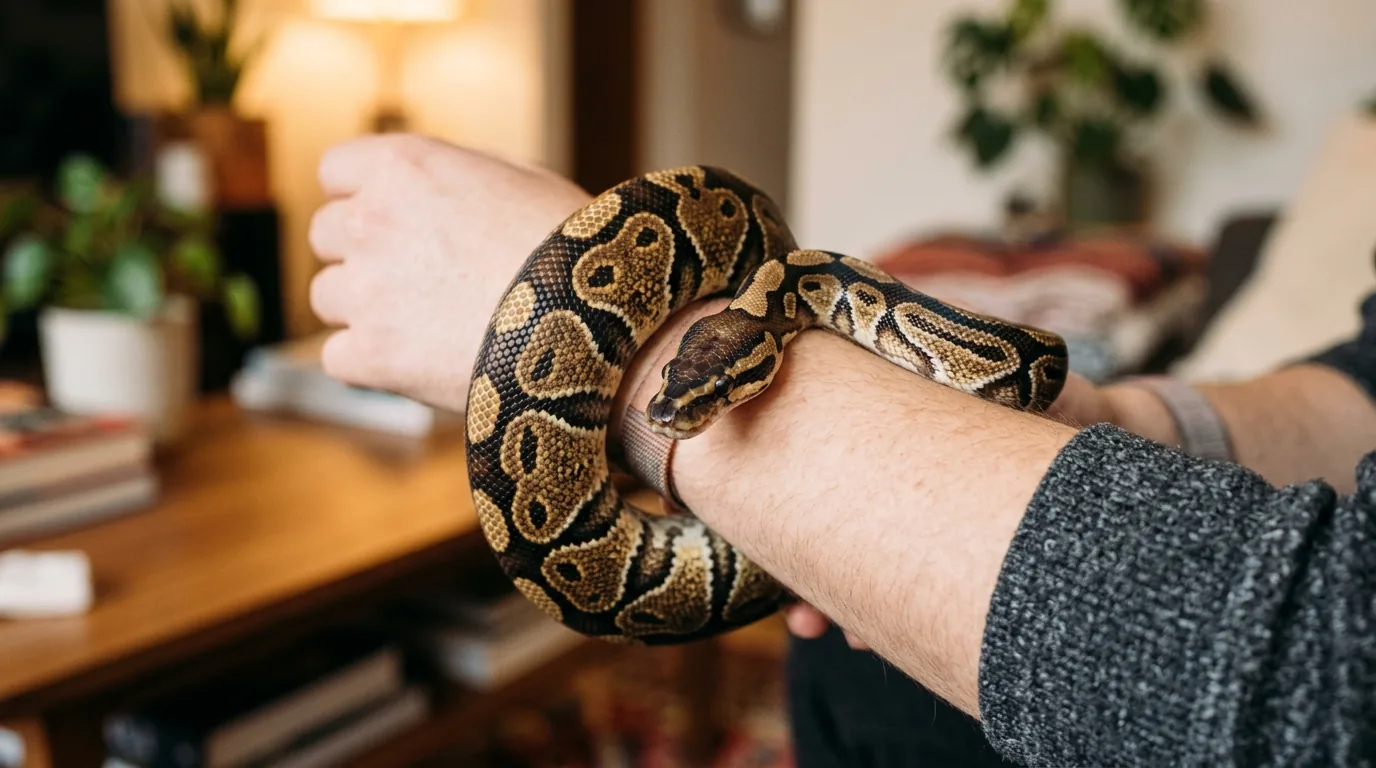
When people hear "python infestation," many immediately worry about the ball python (Python regius), the single most commonly kept pet snake in America. Millions are bred and sold domestically every year. So why hasn't the ball python taken over alongside the Burmese?
The answer is environmental matching. The ball python is native to the arid scrublands and dry savannas of West and Central Africa. It is a small snake, typically 3 to 5 feet, rarely exceeding 6, which makes it vulnerable to native Florida predators like red-tailed hawks, alligators, and even large wading birds. Critically, ball pythons have narrow climate tolerances: temperatures below about 70 degrees Fahrenheit can cause hypothermia and fatal respiratory infection. A single January cold snap in Florida would be lethal.
The Burmese python, by contrast, is a semi-aquatic giant native to the humid, tropical marshes of Southeast Asia. It arrived in an ecological paradise completely devoid of its natural predators (no tigers, no king cobras), stocked with naive prey that had never encountered a large constrictor, and blessed with a climate warm enough to sustain year-round activity. The lesson is stark: an invasive species only becomes catastrophic when the new environment provides everything the animal evolved to exploit, and the Everglades matched the Burmese python like a key fits a lock.
The Ecological Catastrophe: Quantifying a 99% Decline
The most devastating evidence of the python's impact comes from a 2012 study published in the Proceedings of the National Academy of Sciences (PNAS), led by researchers Michael Dorcas and John Willson. The team compared road-survey data from 1996-1997 (before the python population reached critical mass) with surveys from 2003-2011. In areas where pythons had been established the longest, the mammal declines were staggering:
| Native Species | Population Decline | Visual Scale |
|---|---|---|
| Raccoons | 99.3% | |
| Opossums | 98.9% | |
| White-tailed Deer | 94.1% | |
| Bobcats | 87.5% | |
| Marsh Rabbits | ~100% | |
| Cottontail Rabbits | ~100% | |
| Foxes | ~100% |
Marsh rabbits, cottontail rabbits, and foxes were not merely declining. Zero individuals were observed during the later surveys. They had been functionally eliminated from the python-occupied zone. These are not marginal species. Raccoons are keystone scavengers whose near-disappearance cascades through the food web, affecting everything from turtle-nest predation patterns to mosquito host selection. With mid-sized mammals vanishing, mosquito populations have shifted their feeding to Hispid cotton rats, which carry the Everglades virus, potentially increasing the risk of mosquito-borne disease reaching human populations.
Predicting the Spread: Hybridization and the "Super Snake" Threat

The Burmese python's current stronghold spans the southern Everglades, Big Cypress National Preserve, and parts of the Florida Keys. Historically, freezing winter temperatures in central and northern Florida acted as a natural barrier, killing pythons through cold stress. But two converging developments threaten to shatter that barrier.
Climate change is producing milder Florida winters. As freezing nights become rarer, the survival zone for pythons creeps northward. The January 2010 freeze killed many pythons, but survivors may have passed cold-tolerant genes to subsequent generations. Each cold event selects for hardier snakes, meaning the population is slowly evolving to tolerate conditions that would have killed the original imports.
Genetic hybridization is even more alarming. In 2018, USGS geneticist Margaret E. Hunter and colleagues published research in the journal Ecology and Evolution demonstrating that 13 out of approximately 400 sampled Florida pythons carried genetic signatures of the Indian python (Python molurus). The Indian python is naturally adapted to cooler, drier environments than its Burmese relative. This interbreeding, which likely occurred in captivity before the snakes were released, gives the wild population what biologists call "hybrid vigor."
The War in the Swamps: Tactics, Technologies, and Hard Truths
Can the Burmese python be eradicated from Florida? According to the United States Geological Survey, the answer is almost certainly no. The Everglades is a vast, impenetrable wilderness of sawgrass, deep water, and mangrove forest. Pythons are incredibly cryptic. Field biologists estimate they detect fewer than 1 in 100 snakes present in a given area. Total eradication, under current technology, is considered practically impossible.
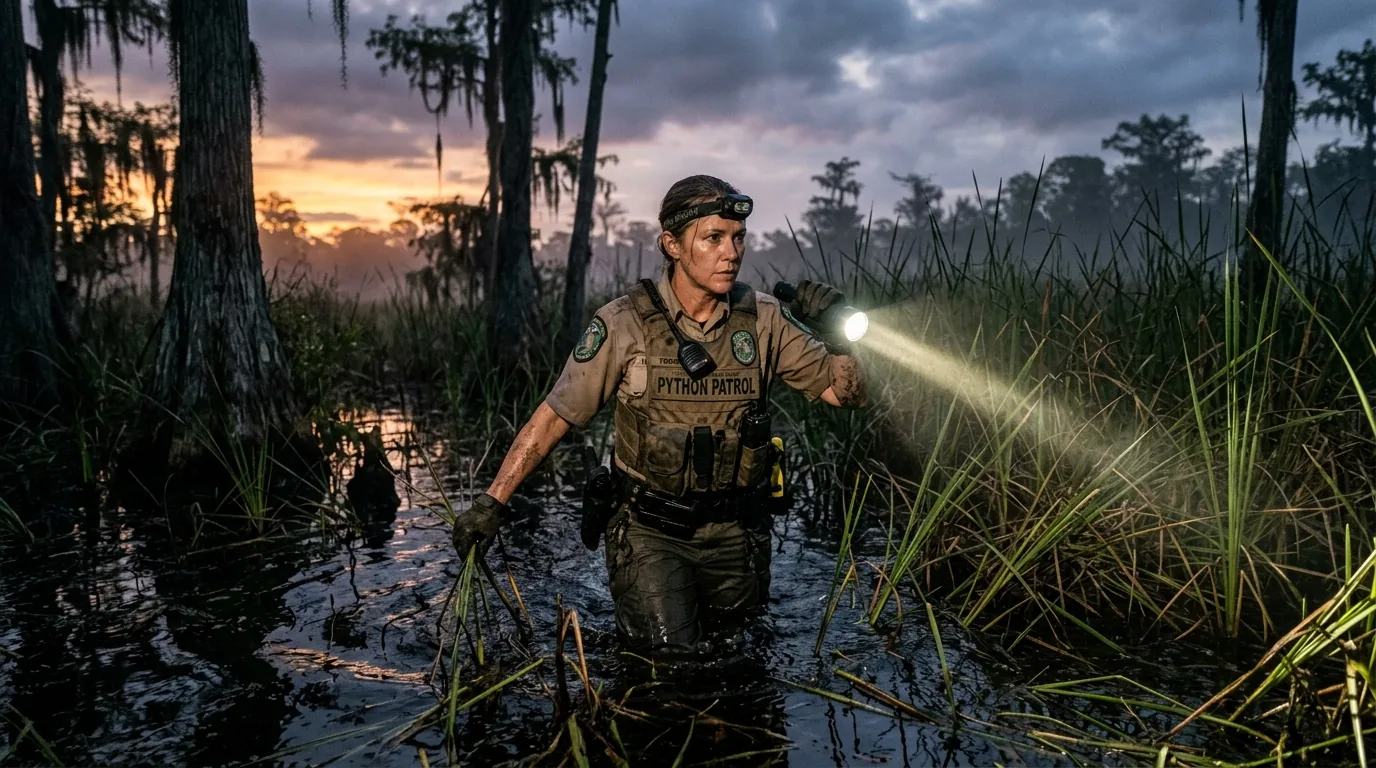
Instead, Florida wages a war of attrition. The primary weapons include:
The Python Elimination Program (PEP)
Run by the South Florida Water Management District (SFWMD) and the Florida Fish and Wildlife Conservation Commission (FWC), this program pays private contractors to hunt and kill pythons across public lands. The economics are precise: contractors earn between $18 and $30 per hour for active surveying, plus a bounty of $50 for any python up to 4 feet and an additional $25 for every foot beyond 4 feet. A verified active nest earns $200. Monthly bonuses of $1,000 go to the top-performing hunter. As of mid-2026, over 23,500 pythons have been removed by state programs combined, with over 2,700 removed in 2025 alone. However, even these numbers barely scratch the surface of the tens of thousands believed to remain.
The "Judas Snake" Program
Operated primarily by the Conservancy of Southwest Florida, this is perhaps the most sophisticated tool in the arsenal. Biologists capture adult male pythons, surgically implant radio transmitters into their body cavities, and release them back into the wild. During the breeding season (typically December through April), these "scout" or "Judas" males are tracked by helicopter and on foot as they slither deep into the swamp, inevitably seeking out reproductive females. When the male finds a breeding aggregation, sometimes multiple females and several competing males tangled together, researchers move in, remove the females and untagged males, and release the Judas snake to lead them to the next group. Since 2013, this program has removed over 1,750 pythons and prevented an estimated 20,000+ eggs from hatching.
Emerging High-Tech Detection
Traditional hunting barely scratches the surface. Newer approaches include eDNA (Environmental DNA) analysis, where researchers test water and soil samples for python genetic material using advanced tetraplex digital PCR assays developed at the University of Florida. Uncrewed aircraft systems (drones) equipped with near-infrared and thermal imaging are being tested to spot the snakes' heat signatures from the air. Around 2025, teams from SFWMD and UF deployed experimental AI-powered robotic decoys, solar-powered robots that emit heat and scent to lure pythons out of hiding for capture.
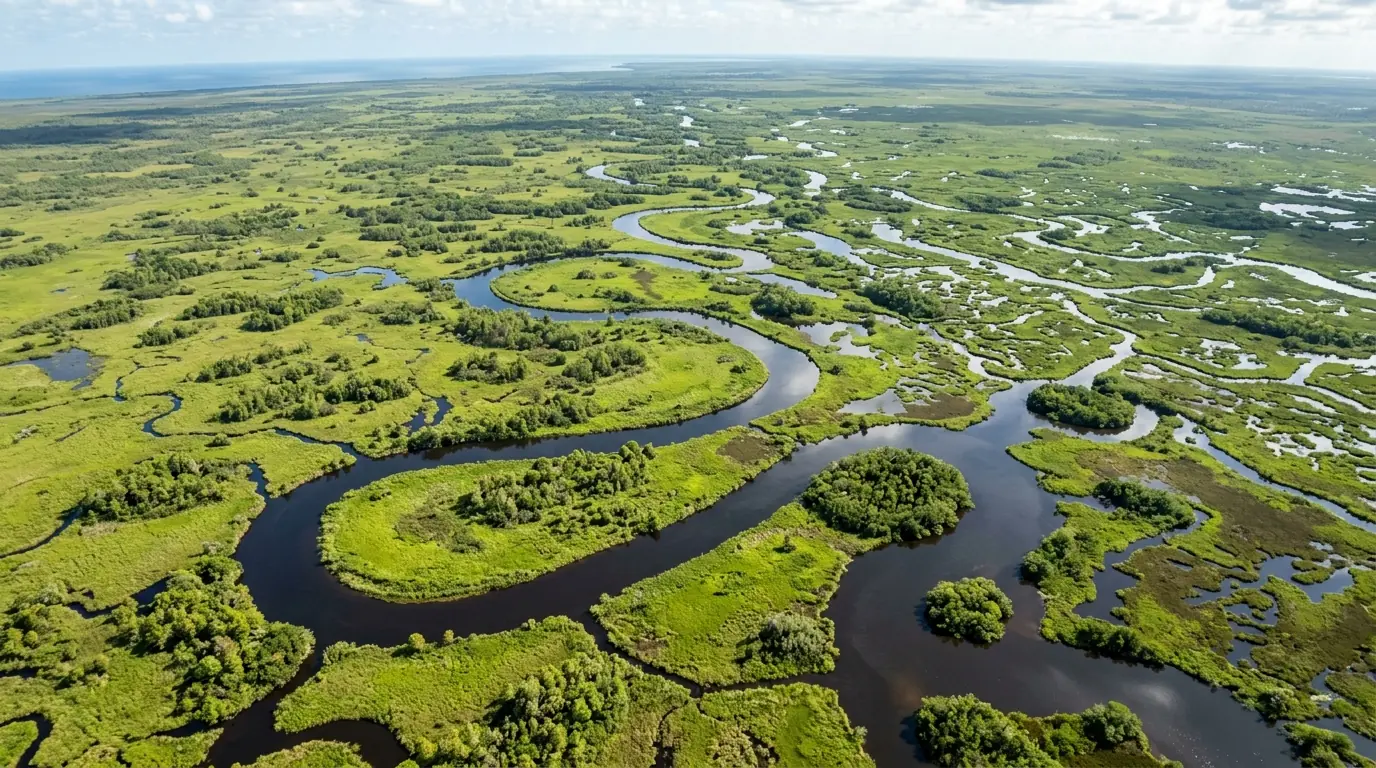
Watch: Everglades Invasives
This official mini-documentary from Everglades National Park examines the impact of invasive species like the Burmese python on the fragile South Florida ecosystem, directly from the perspective of the park rangers and biologists fighting the invasion on the front lines.
Frequently Asked Questions
Do Burmese pythons attack humans in Florida?
Unprovoked attacks on humans by wild Burmese pythons in Florida are virtually non-existent. While they are physically capable of injuring a person, wild pythons overwhelmingly avoid human contact. The primary danger they pose is ecological. The handful of fatal python incidents in the US have involved captive snakes kept as pets in homes, not wild Everglades animals.
How many pythons are actually in the Everglades?
No one knows for certain. The USGS and FWC officially cite a conservative estimate of "tens of thousands." Some media reports cite "hundreds of thousands," but this figure is speculative. The snakes' extreme camouflage and the inaccessible terrain make an accurate census functionally impossible with current technology.
Can cold weather solve the problem?
Severe cold snaps like the January 2010 freeze have killed significant numbers of pythons, but the population rebounds within two years. Survivors pass cold-tolerant genes to the next generation, and hybridization with Indian pythons could further extend their cold tolerance. Climate change is making severe freezes less frequent, reducing this natural control mechanism over time.
Is the ball python also a threat to the Everglades?
No. Despite being the most popular pet snake in America, ball pythons are too small (3-5 feet), too climate-sensitive (temperatures below 70 degrees Fahrenheit cause hypothermia), and too vulnerable to native predators to establish a breeding population in the US. The Burmese python's invasion succeeded because it perfectly matched the Everglades environment. The ball python does not share this match.
What should I do if I find a python in Florida?
Do not attempt to capture or kill a large python yourself. Report the sighting immediately to the Florida Fish and Wildlife Conservation Commission (FWC) using the IveGot1 reporting app or their Exotic Species Hotline at 1-888-IVE-GOT1. Provide the exact GPS location and a photograph if safe to do so.
What is the largest python ever caught in Florida?
The longest Burmese python on record in Florida was 19 feet long and weighed 125 pounds. It was captured by hunter Jake Waleri in Big Cypress National Preserve on July 10, 2023. The heaviest specimen, a separate individual, weighed 215 pounds and measured nearly 18 feet, captured by the Conservancy of Southwest Florida in June 2022.
The Burmese python invasion is not a problem that will be solved. It is a permanently altered reality. Every night, in thousands of square miles of American wetland, an apex predator from another continent hunts animals that have no evolutionary defense against it. Scientists and hunters are fighting with radio transmitters, per-foot bounties, drones, and genetic analysis. They are not fighting to win. They are fighting to slow the damage enough to preserve what remains of one of America's most irreplaceable ecosystems.
Key sources
- Dorcas, M. E., et al. (2012). Severe mammal declines coincide with proliferation of invasive Burmese pythons in Everglades National Park. Proceedings of the National Academy of Sciences 109(7):2418–2422.
- Hunter, M. E., et al. (2018). Genetic analysis of invasive pythons in Florida reveals new genetic lineages. Ecological Applications 28(2):565–574.
- U.S. Geological Survey (2025). Burmese python invasion in southern Florida: distribution, impacts, and management.
- U.S. Fish & Wildlife Service (2025). Python Elimination Program — South Florida.


Loading comments…