


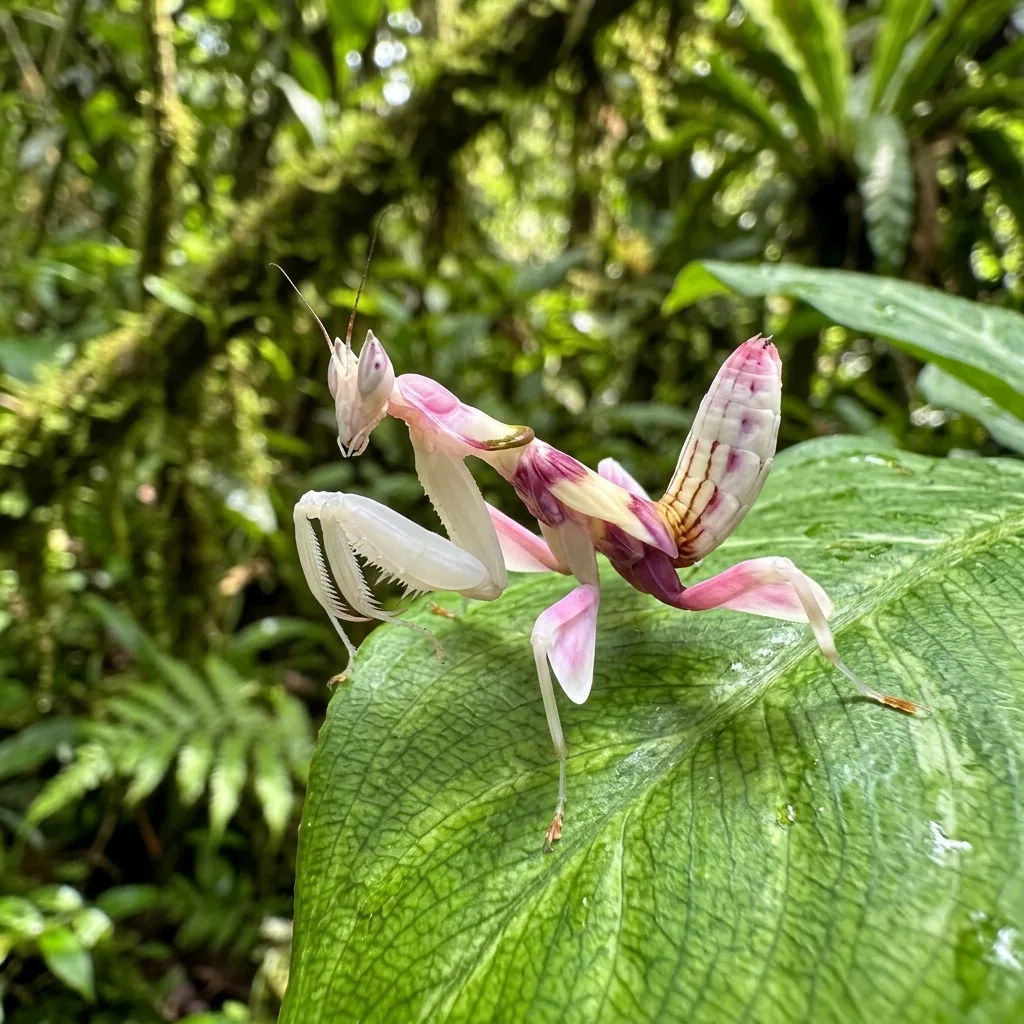
Nature is full of animals that use camouflage to blend into their surroundings and avoid being eaten. But what happens when an animal uses its disguise not to hide in the shadows, but to step into the sunlight and trick its prey into flying right into its grasp? This is the predatory strategy of the orchid mantis (Hymenopus coronatus), a visually striking insect found in the rainforests of Southeast Asia. By examining how this mantis lives, hunts, and grows, the reader can decode fundamental biological concepts that govern all wildlife: taxonomy, behavior, evolutionary biology, and ecological niches.
Taxonomy: Placing the Mantis in the Tree of Life
Taxonomy is the science of naming, describing, and classifying organisms. It provides a universal language for scientists to understand how different species are evolutionarily related to one another. Examining an animal's taxonomic classification is, in effect, tracing its family tree back through millions of years of evolution.
The orchid mantis belongs to the kingdom Animalia and the class Insecta. Digging deeper into its specific lineage, it is classified under the order Mantodea, which contains all praying mantises across the globe. Within this order, it belongs to the family Hymenopodidae, a specialized group commonly referred to as "flower mantises" because many of its members exhibit stunning floral coloration.
Understanding taxonomy tells us that despite its delicate, petal-like appearance, Hymenopus coronatus shares the same underlying predatory anatomy as the common green praying mantises found in backyard gardens. It possesses powerful raptorial forelegs designed with sharp spikes to snatch and grip prey, and a highly mobile triangular head that allows it to track movement with surgical precision.
Behavior and Evolution: The Art of Conspicuous Masquerade
In ecology, an animal's behavior encompasses everything it does to interact with its environment, survive, and reproduce. While many animals use defensive camouflage (known as crypsis) to avoid detection entirely, the orchid mantis employs a specialized evolutionary behavior known as "conspicuous masquerade." In a conspicuous masquerade, the animal actively wants to be seen by other creatures—it just wants to be misclassified. It wants a passing butterfly to see it and think, "That is a flower," rather than "That is a predator."
This is a form of aggressive mimicry. Instead of merely hiding, it uses a "false promise" of nectar to actively lure prey within striking distance. For a long time, early naturalists assumed that the orchid mantis simply hid among specific orchids, waiting in ambush for insects that came to the real flower. However, rigorous research led by evolutionary biologist James C. O'Hanlon and published in The American Naturalist in 2014 demonstrated exactly how this deception operates in the wild.
The researchers placed orchid mantises on plain green leaves in the forest, completely isolated from real flowers, and observed them. Remarkably, they found that the mantises attracted wild pollinators—like bees and butterflies—at rates even higher than some actual, nectar-producing flowers. The research also busted a popular myth: the mantis does not mimic one single, specific species of orchid. Instead, it presents a generalized "super-flower" appearance. Its bright colors, UV reflectance, and petal-shaped legs tap into the hardwired visual preferences of pollinating insects, effectively hacking their brains to draw them close.
Evolutionary Pressures: Sexual Dimorphism and Life Cycles
The physical appearance of the orchid mantis isn't just about mimicking a flower; it's a profound showcase of evolutionary pressures at work. One of the most striking features of Hymenopus coronatus is its extreme "sexual dimorphism"—a biological term describing distinct differences in size or appearance between the sexes of the same animal.
In the case of the orchid mantis, adult females are massive compared to the males. A female can grow up to two and a half inches long, while a male might barely reach an inch. Evolutionary biologists theorize that this extreme size difference is driven by female-biased selection. Because females require an immense amount of energy to produce and lay egg cases (oothecae), evolution favored larger females that were capable of capturing large, energy-rich pollinators like butterflies and big bees. The tiny males, unburdened by egg production, remained small, allowing them to mature much faster and focus solely on flying through the canopy to find a mate.
The mantis also undergoes dramatic "ontogenetic shifts"—meaning its appearance changes drastically depending on its life stage. When orchid mantis nymphs first hatch, they do not look like pink and white flowers. Instead, they sport a striking red-and-black coloration. Scientists believe this early stage acts as a form of defensive mimicry, making the tiny, vulnerable nymphs look like toxic assassin bugs to deter predators. It is only after they molt and grow larger that they shed their warning colors and adopt the beautiful, lethal floral disguise they are famous for.
Ecological Niche: A Specialized Role in the Rainforest
An ecological niche is more than just where an animal lives; it is the organism's specific "job" or role in its ecosystem. It encompasses what the animal eats, what eats it, how it interacts with other species, and how it utilizes its physical environment.
The niche of the orchid mantis is that of a highly specialized ambush predator in the humid, tropical rainforests of Southeast Asia, including Malaysia and Indonesia. By preying primarily on pollinating insects, the mantis acts as a natural population control mechanism within its habitat. In turn, it serves as potential prey for larger insectivores, such as birds, reptiles, and primates—though its floral disguise helps mitigate this risk, as birds are generally not interested in eating flowers.
This specific niche is highly dependent on a thriving ecosystem. If a rainforest were to lose its floral diversity due to deforestation or climate change, the aggressive mimicry strategy of the orchid mantis would become ineffective. Pollinators would no longer frequent the area looking for flowers, illustrating exactly how tightly interwoven an organism's niche is with the surrounding web of life.
Frequently Asked Questions
Do orchid mantises only eat bees and butterflies?
While their primary hunting strategy targets pollinators drawn to their floral appearance, they are highly opportunistic predators. They will readily consume flies, moths, crickets, and occasionally even small vertebrates like tiny lizards if the opportunity arises and the prey is appropriately sized for the mantis's powerful forelegs.
Are they completely protected from predators?
No animal is completely safe in the rainforest. While their masquerade strategy successfully fools many birds and reptiles into thinking they are inedible flowers, they can still fall victim to predators that hunt by scent or movement, such as certain species of monkeys, spiders, or larger predatory insects.
Why don't they just hunt actively like other predators?
Active hunting, like a wolf chasing a deer, requires a massive expenditure of energy and increases the risk of being spotted by larger predators. The aggressive mimicry strategy allows the orchid mantis to conserve precious calories by remaining completely still and letting its meal come to it.
The orchid mantis proves that the natural world rarely relies on passive strategies. Through its taxonomic lineage as a flower mantis, its reliance on conspicuous masquerade, its extreme sexual dimorphism, and its tightly bound ecological niche in the rainforest, this deceptive insect offers a perfect blueprint for understanding the complex, beautiful, and ruthless strategies wildlife use to survive.
Key sources
- O’Hanlon, J. C., Holwell, G. I., & Herberstein, M. E. (2014). Pollinator deception in the orchid mantis. The American Naturalist 183(1):126–132.
- Wizen, G., & Gasith, A. (2011). Sexual dimorphism in the orchid mantis (Hymenopus coronatus). Naturwissenschaften 98(5):417–421.
- National Geographic (2024). Orchid mantis: a flower-mimicking predator.


Loading comments…