


The flying lizard in India is Draco dussumieri, a tree-dwelling agamid known as the Indian flying lizard, southern flying lizard and Western Ghats flying lizard. It does not fly by flapping wings. It glides from tree to tree after spreading skin membranes supported by six elongated ribs.
On bark, the same animal can be remarkably difficult to see. Its narrow body and broken brown-grey pattern resemble scars, lichen and shadow. Then it turns head-down, judges a gap and jumps. The folded membranes open, the limbs change position and a lizard that looked almost flat against the trunk becomes a steerable glider.
Indian flying lizard identification at a glance
The diagnostic account in The Reptile Database lists a maximum snout-to-vent length of 97 millimetres. That measurement excludes the tail. The same account notes upward-facing nostrils, six patagial ribs and hindlimbs roughly as long as the distance between the forelimb and hindlimb attachments. Those details are more reliable for identification than colour alone, because bark pattern and display colours vary with sex, posture and individual.

Where is the flying lizard found in India?
Draco dussumieri is a peninsular Indian species most closely associated with the Western Ghats. Records extend along the Ghats from the north into the humid southern ranges, and the species has also been reported from hill forests in the southern Eastern Ghats. The taxonomic range summary includes Maharashtra, Goa, Kerala and Tamil Nadu among its Indian localities. A 2025 phylogeographic study sampled the Western Ghats and also identified southern Eastern Ghats localities where the lizard was observed.
This is not a lizard of open plains. It needs upright surfaces and a usable three-dimensional route through vegetation. Moist and semi-evergreen forest are important, but the animal can also occupy shaded plantations where mature trunks and connected canopy remain. A plantation record should not be read as proof that any farm can replace native forest: tree spacing, shade, prey and canopy continuity determine whether gliding routes still exist.
For wildlife watchers, distribution records are only the first clue. Search tree trunks rather than open sky, especially where morning light reaches otherwise shaded bark. A stationary lizard may look like a slightly irregular strip of bark. When approached, it may move around to the far side of the trunk before it chooses to glide.
How the Indian flying lizard glides
The main gliding surface is the patagium, a membrane folded along each flank. Six elongated thoracic ribs swing outward to support it. This differs from the wing of a bird or bat: the lizard’s forelimb bones do not form the frame of the main flight surface.
That separation once created a mechanical puzzle. If the ribs open the membrane, how does the lizard hold and steer it? Zoologist J. Maximilian Dehling analysed take-off and gliding sequences across Draco. His open-access 2017 study in PLOS ONE showed that, after launching, the lizard reaches its forelimbs backward, grasps the leading edges of the patagia and pulls them forward. The arms and hands tension and control the paired membranes.
Just before contact with the next trunk, the forefeet release the patagia and swing forward for landing. The ribs provide the broad surface, the forelimbs control its front edge and the long tail contributes stability. The animal assembles this composite wing for a few seconds and folds it away once all four feet are back on bark.
Glide distance changes with launch height, target height, body size and the gap between trees. A single claimed maximum therefore tells little about everyday movement. In habitat, the more useful ability is controlled transfer between vertical trunks without descending to the forest floor and climbing again.
What do the forelimbs and hindlimbs do?
A hindlimb is simply a rear leg. It is an anatomical term used for lizards and many other four-limbed vertebrates; it is not the name of a special group called a “hindlimb lizard.” In descriptions of D. dussumieri, forelimb and hindlimb proportions help taxonomists compare the species with other Draco.
The two limb pairs do different jobs during a glide. The hindlimbs generate the push away from the trunk at launch and are held in a posture that helps keep the body balanced once airborne. The forelimbs then reach back to take control of the patagia. As the target approaches, the forelimbs come forward first to meet the bark, while the hindlimbs follow and help secure the landing.
This is why calling the patagium a skin flap between the legs is misleading. In Draco, the large membrane is mounted on elongated ribs. The limbs interact with that rib-supported surface, but neither the front nor rear legs act as the long internal wing spars seen in bats. The unusual feature is the coordination of ordinary climbing limbs with a separately supported gliding membrane.
Watch a southern flying lizard in the Western Ghats
This short field film from the Kanniyakumari Nature Foundation shows an Indian flying lizard in Kalakkad Mundanthurai Tiger Reserve. It shows the animal’s bark camouflage, display structures and movement in Western Ghats habitat.
Why glide when it can climb?
Descending to the ground costs height and exposes a tree specialist to a different set of hazards. Gliding offers a direct route across a canopy gap. It can move a lizard through its feeding area, toward a mate or away from a rival while preserving much of the height already gained.
D. dussumieri is active by day. Much of its time is spent clinging to trunks and searching bark for small arthropods, especially ants. Camouflage is most effective when the patagia are folded, because the body then presents a narrow outline and mottled flanks rather than two conspicuous membranes.
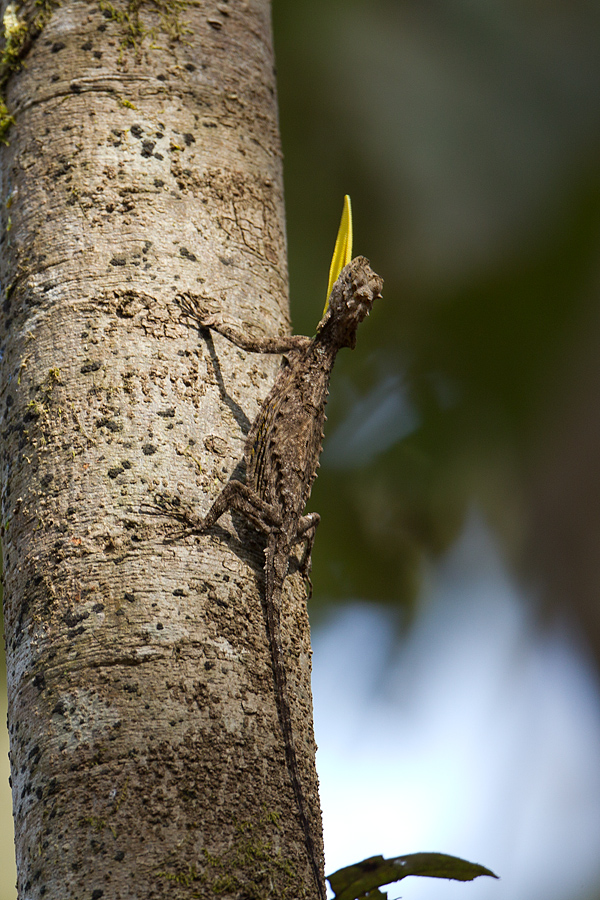
The bright signal hidden inside a bark-coloured lizard
Males can become conspicuous in an instant by extending a long yellow throat fan called a dewlap. They also expose patterned patagia during displays. The colour can be hidden again when the exchange ends, allowing the same individual to alternate between camouflage and a visible social signal.
A male may flick the dewlap repeatedly while changing posture on a trunk. Displays are used in territorial encounters and courtship, and a rival may be chased to another tree. Females are arboreal too, although egg laying requires a brief trip to the ground. The species is oviparous, meaning it reproduces by laying eggs.
Forest structure matters as much as forest area
A gliding lizard experiences habitat as a network of launch and landing surfaces. Removing a mature tree changes more than the number of available perches: it changes the geometry of nearby routes. Wide gaps, loss of shaded trunks and reduced insect abundance can make an apparently green landscape less useful.
A 2013 photographic capture-recapture study examined D. dussumieri in an agricultural landscape without permanently marking the lizards. Researchers used stable patterns on the patagia to recognize individuals in later photographs. The membrane was therefore both a gliding surface and a non-invasive identity record.

Two lineages separated more by rainfall than rock
The most revealing recent work on this flying lizard concerned DNA and climate rather than flight. Chaitanya and colleagues combined mitochondrial DNA, genome-wide SNP markers and climatic data. Their 2025 Molecular Ecology study found strong evidence for northern and southern lineages that diverged during the early Pleistocene.
The lineages are not separated by a clean physical wall. Animals with mixed ancestry occur across a broad central Western Ghats contact zone, including Wayanad, Coorg and the Agumbe plateau. Migration continued after the initial split, but gene flow was not high enough to erase the genetic difference.
The transition corresponds more closely to a change in rainfall regimes than to a major mountain gap. The analysis supported isolation by environment, especially precipitation seasonality, more strongly than isolation by distance. During the Last Glacial Maximum, modelled suitable ranges were broader and the climatic boundary appears to have been more permeable.
These findings should not be translated into two formally named species without a taxonomic revision. The paper presents evidence of independently evolving lineages, admixture and possible speciation. The accepted name used by current taxonomic databases remains Draco dussumieri.
How to spot one without disturbing it
Look for a slight mismatch in bark texture before looking for open “wings.” Early sun on shaded trunks can be productive because these reptiles are diurnal. Give the animal space: moving close may cause it to hide on the reverse side of the trunk.
Do not tap a tree or chase a lizard to force a glide. That spends the animal’s energy for a photograph and can separate it from the route it chose. If it launches naturally, watch the destination trunk rather than trying to follow the body in mid-air. The patagia fold quickly after landing and the camouflage returns almost at once.
Frequently asked questions
Is the Indian flying lizard poisonous or venomous?
Draco dussumieri is not known as a venomous or poisonous lizard. It is a small insect-eating tree lizard whose main defences are camouflage, moving around the trunk and gliding away. It should still be observed without handling.
Can the flying lizard actually fly?
It glides rather than performing powered flight. The animal loses height as it crosses a gap and does not produce repeated wingbeats like a bird or bat. Its control over the patagia nevertheless allows directional movement and a precise landing on a vertical trunk.
Is “hindlimb lizard” another name for Draco dussumieri?
No. Hindlimb means rear leg, so “hindlimb lizard” is an anatomical search phrase rather than a recognized common name. The accepted common names include Indian flying lizard, southern flying lizard, Western Ghats flying lizard and Dussumier’s flying lizard.
Do the hindlimbs form the wings?
No. Six elongated ribs support each patagium. The hindlimbs contribute to launch, posture and landing, while the forelimbs grasp and control the front edges of the membranes during gliding.
Where is the best place to look for this lizard?
Its core range is in the Western Ghats. Within suitable forest or shaded tree-rich habitat, scan medium and large trunks in daylight, particularly warm patches near shade. Local wildlife rules and access restrictions should always be followed.
A lizard built for life between trunks
The Indian flying lizard succeeds through coordination rather than a single wing-like organ. Ribs deploy the membranes, forelimbs control them, hindlimbs launch and help complete the landing, and the tail stabilizes the crossing. That sequence lasts only seconds. Once the patagia close, Draco dussumieri becomes a bark-coloured tree lizard again—and the best way to see it is to let it choose when to move.
Sources and further reading
- Chaitanya, R. et al. (2025). “Speciation in the Peninsular Indian Flying Lizard (Draco dussumieri) Follows Climatic Transition and Not Physical Barriers.” Molecular Ecology 34(12): e17800. DOI: 10.1111/mec.17800.
- Dehling, J. M. (2017). “How lizards fly: A novel type of wing in animals.” PLOS ONE 12(12): e0189573. Open-access paper.
- McGuire, J. A. & Dudley, R. (2011). “The Biology of Gliding in Flying Lizards (Genus Draco) and their Fossil and Extant Analogs.” Integrative and Comparative Biology 51(6): 983–990. Journal record.
- Sreekar, R. et al. (2013). “Photographic Capture-Recapture Sampling for Assessing Populations of the Indian Gliding Lizard Draco dussumieri.” PLOS ONE 8(2): e55935. Open-access paper.
- Uetz, P. et al. Draco dussumieri species account, The Reptile Database (accessed 2 August 2026).


Loading comments…